Splitting: When Someone You Love Becomes All Bad (Or All Good)
You're sitting across from your partner, and something shifts. Five minutes ago, they were the person you loved. Now, in your mind, they're selfish, uncaring, and you can't remember why you're even together. Or the opposite happens—someone who frustrated you yesterday is suddenly perfect again, and you can't fathom why you were ever upset.
This is splitting, and if you're experiencing it or watching it happen in your relationship, you're not alone.
What Is Splitting?
Splitting is when someone sees things in black and white—no gray area, no middle ground. People are good or bad. Situations are entirely right or entirely wrong. One moment, your partner is the love of your life. The next moment, they're the enemy. There's no room for the idea that someone can be imperfect and still lovable, or that you can have conflicting feelings about the same person at the same time.
Splitting is a defense mechanism—a psychological response that happens when our brains are overwhelmed and struggling to make sense of contradictory information about a person or situation. Instead of holding two opposing truths ("I love my partner AND I'm furious with them right now"), the mind simplifies: it's one or the other. All good or all bad.
This isn't the same as just being upset or changing your mind about someone. Splitting is more sudden, more intense, and more absolute. It shows up as explosive anger, feelings of intense abandonment or betrayal, dramatic statements about the relationship, and a complete inability in the moment to access the positive feelings you had before.
What Does Splitting Look Like?
If you're splitting, or if you're in a relationship with someone who does, you'll recognize some of these patterns:
Sudden emotional shifts. Your partner says something that lands wrong, and your entire perception of them changes in minutes—or seconds. What you valued about them moments ago feels like a lie.
Extreme blame. When conflict happens, it's entirely their fault. You have no part in it. Any suggestion that you might have contributed feels like an attack on your character.
Playing the victim. You see yourself as the wronged party in the relationship—or in life. Others don't understand how much you're suffering. The narrative becomes: I'm betrayed, they're bad, nobody cares about me.
Difficulty seeing nuance. Your partner isn't just annoying right now—they're a fundamentally terrible person. Your job isn't just stressful—it's soul-crushing and hopeless. A mistake isn't a mistake; it's evidence of your own unworthiness or their cruelty.
Idealization followed by devaluation. In the early days, your partner seemed perfect. Then, gradually or suddenly, you began to notice all the ways they're failing you. Now you can barely remember what you liked about them.
Intense, unstable relationships. Relationships cycle between deep attachment and sudden distance. You might threaten to leave, then panic at the thought of them leaving you. You alternate between clinging and pushing away.
Where Does Splitting Come From?
Splitting doesn't happen in a vacuum. It's a coping mechanism that develops when someone's emotional needs haven't been consistently met. If the people who were supposed to care for you were emotionally unavailable, inconsistent, or unresponsive to your pain, your nervous system learned to protect itself by simplifying the world into safe and unsafe, good and bad.
When you couldn't predict whether your caregiver would be warm or rejecting—or when your emotional needs were ignored or dismissed—your brain developed splitting as a way to survive. It's a protective response: if I can't trust this person to be reliably there for me, then I'll decide they're either entirely safe or entirely dangerous. It's painful, but it feels safer than holding the painful truth that someone matters to you and can also hurt you.
This pattern can show up in people with various experiences and backgrounds, and while it's often associated with certain diagnoses, splitting itself isn't a diagnosis—it's a behavior and a way of processing emotions that many people struggle with.
Splitting and Borderline Personality Disorder (BPD)
Splitting is often discussed in relation to Borderline Personality Disorder, so it's worth understanding the connection. BPD is a pattern of emotional intensity, unstable relationships, a fragile sense of self, and deep fears of abandonment. People with BPD often experience splitting as part of their symptoms.
Here's what research shows: BPD doesn't develop because someone is broken or "bad." It develops in response to an invalidating environment—one where emotional needs went unmet, where caregiving was unpredictable or unresponsive, or where a person's feelings were consistently dismissed or denied. When children don't receive the emotional attunement and consistency they need to develop a stable sense of self and others, they develop survival strategies—and splitting is one of them.
The important thing to know is that BPD isn't as scary as it sounds, and it isn't a life sentence. With proper treatment and support, people with BPD can build secure, stable relationships. You don't have to be perfectly securely attached to have a loving, stable partnership. Even with BPD, people can develop the skills to recognize their triggers, regulate their emotions, and create the kind of relationship they want.
The Triggers Behind Splitting
Splitting doesn't happen randomly. There's always something beneath it—even if the trigger seems small from the outside. Common triggers include:
Fear of abandonment. A partner is late coming home, or they mention needing space. The fear of being left activates intensely, and suddenly they're the bad guy for making you feel this way.
Feeling unheard or invalidated. Your partner disagrees with you, seems dismissive, or doesn't respond the way you need them to. In the moment, it feels like they don't care about you at all.
Perceived rejection. They prioritize something else (work, friends, family) over you. They're tired and can't engage with your emotions right now. They set a boundary. Any of these can trigger the thought: They don't love me. They never did.
Unmet needs. You need reassurance, presence, or emotional support, and it's not there. Instead of asking or tolerating the disappointment, your brain flips: they're the problem, not the gap between what you need and what they're offering.
Shame or feeling exposed. You've shared something vulnerable, or you've made a mistake, and now you feel deeply ashamed. That shame gets projected outward: They're judging me. They'll leave me. They think I'm broken.
The trigger is often real—your partner did forget something, or was dismissive—but the intensity and totality of the response is what distinguishes splitting from a normal reaction to a normal problem.
How Splitting Damages Relationships
When splitting happens, the relationship takes damage. Here's why:
Your partner can't win. In the moment, they're the villain. Anything they say or do gets filtered through that lens. An apology feels insincere. An explanation feels like a lie. Comfort feels patronizing.
The relationship becomes unpredictable. Your partner never knows which version of you they'll get, or which version of themselves you'll see them as. This creates anxiety and exhaustion on both sides.
Repair becomes nearly impossible. Splitting creates a narrative where the other person is fundamentally bad or uncaring. From that vantage point, there's nothing to repair—there's just damage that can't be undone. The relationship feels broken beyond recovery.
Trust erodes. If the person you love can become the enemy in an instant, your partner starts protecting themselves emotionally. They become guarded, distant, or hypervigilant to avoid triggering another episode. The intimacy dies.
You become the problem. From your partner's perspective, they can't do anything right. So they may start to believe they are the problem, or they may give up trying. Either way, the relationship suffers.
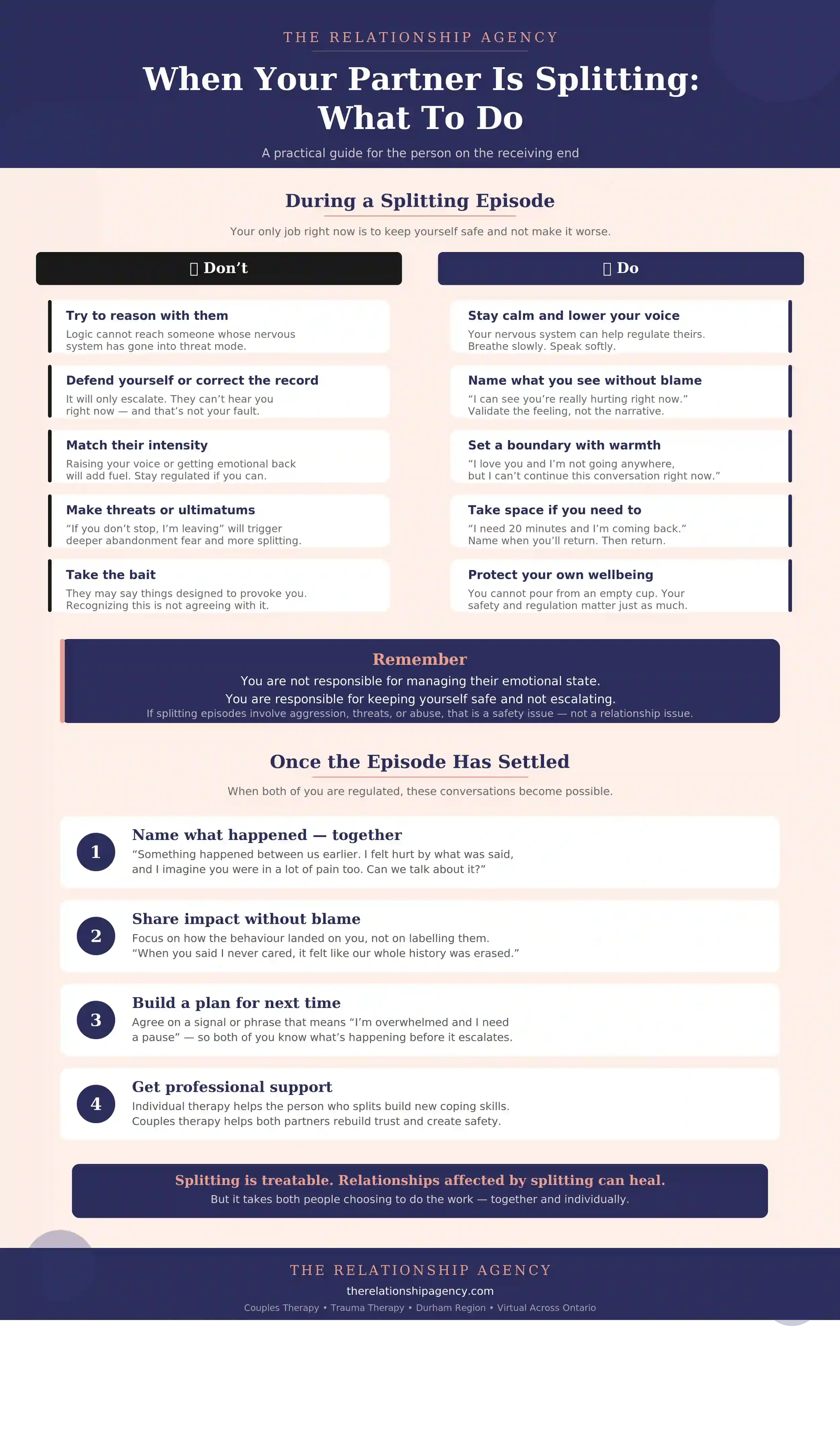
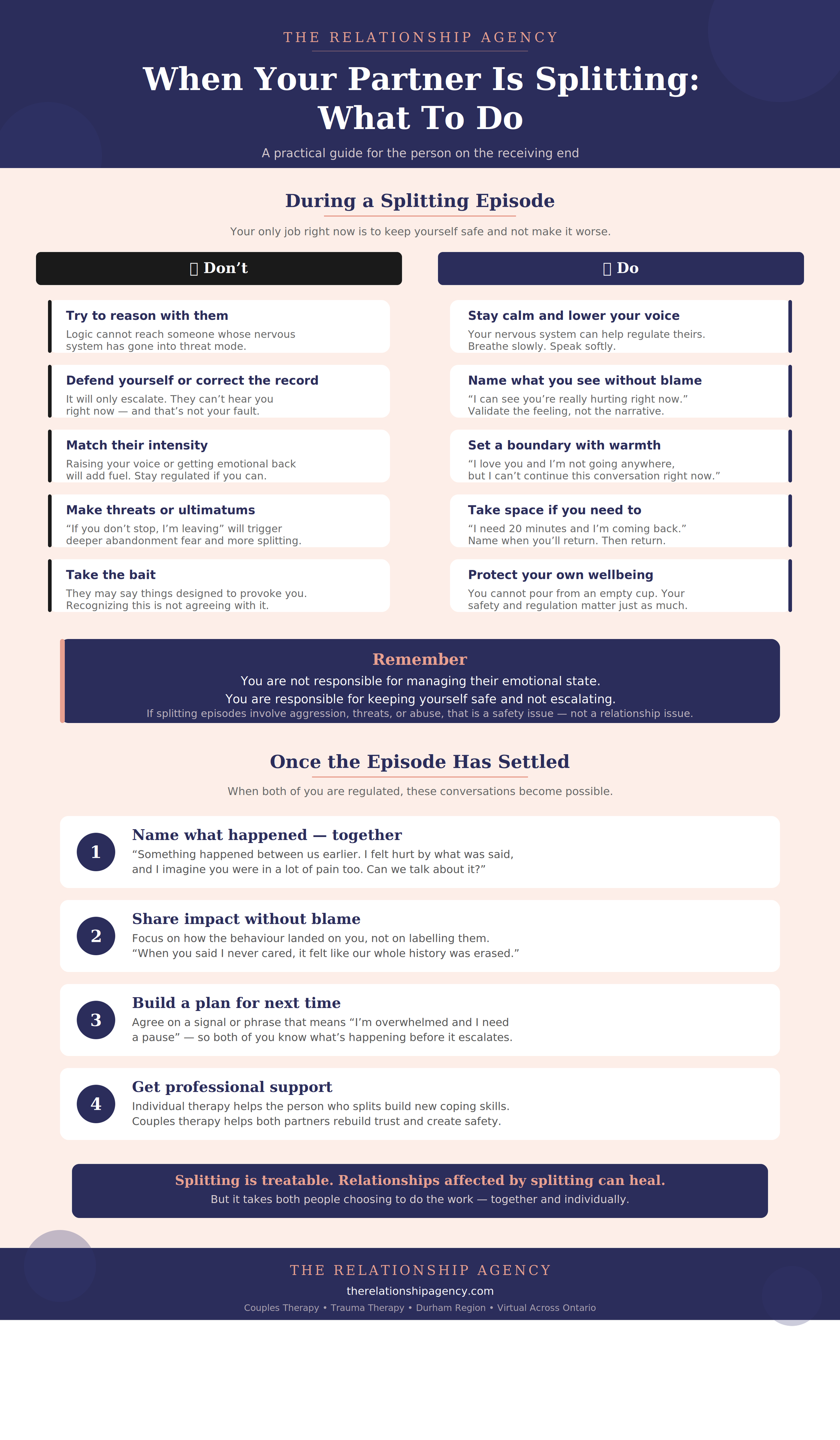
What NOT To Do During a Splitting Episode
During a splitting episode, the couple cannot work through the conflict together. This is the key insight that changes how you approach this.
When someone is actively splitting—when rage is escalating, when they're overwhelmed and seeing you as entirely bad—trying to reason with them, explain yourself, or work it out will backfire. Here's why: their nervous system is flooded. The rational part of their brain that can hear nuance, consider your perspective, and remember that they love you is offline. Engagement in the moment doesn't help; it often escalates.
So what shouldn't you do?
Don't try to argue or defend yourself. This will be heard as proof that you don't care, that you're selfish, that you're the bad guy.
Don't try to reassure them. "I love you" or "I'm not leaving" won't land. It will feel empty or false.
Don't try to fix it right now. There is no fixing this in the moment. The episode needs to pass first.
Don't take it personally—and don't act like you do. If you respond with hurt or defensiveness, it escalates the situation. This is about their nervous system, not about you.
Don't punish them or withdraw affection. Yes, they hurt you. Yes, you're angry. But in this moment, you need to stay steady. Retaliation will only create more damage and more fear.
What TO Do During a Splitting Episode
The job during a splitting episode is to stay safe and wait for it to pass. I recommend creating agreements together in moments of calm about what you will do when splitting happens. This is particularly important so that walking away doesn’t feel like abandonment and become more triggering.
If your partner is splitting, particularly if it's paired with rage or is escalating:
Create distance. Remove yourself from the situation. Go to another room. Leave the house if you need to. This isn't punishment; it's protection for both of you. It also removes the audience, which can sometimes de-escalate the episode.
Keep your responses minimal. If you need to communicate, keep it short, calm, and neutral: "I can see you're upset. I'm going to step away right now. We can talk when you're ready." Then go.
Don't engage with the content. Don't argue about whether you're a bad person, whether you never cared, whether the relationship is over. These are the thoughts of an activated nervous system, not truths about reality or about you.
Take care of yourself. Breathe. Ground yourself. Remind yourself that this is temporary and that it's not about you. Reach out to a friend or therapist if you need support.
Wait. The episode will pass. It might take minutes or hours, but the nervous system will eventually settle. Their brain will come back online. And when it does, the person you know will return.
Once the episode has passed and everyone is calmer, you can reconnect and have a conversation about what happened. But that conversation needs to happen in a regulated state, not in the heat of the moment.
The Real Work: Individual Therapy
Here's the critical truth: the person who is splitting needs individual therapy. The relationship itself is not the place to work on this.
With a good therapist, someone who struggles with splitting can:
Learn to recognize the triggers before the nervous system floods. This is the prevention layer.
Develop emotion regulation skills that make the intensity of the reaction less overwhelming. This takes practice and time, but it's possible.
Understand the root causes of why abandonment or rejection feels so catastrophic. Usually, this goes back to early experiences where emotional needs weren't reliably met.
Build object constancy—the ability to hold both positive and negative feelings about someone at the same time, and to remember that someone can be imperfect and still love you.
Process trauma or grief that might be driving the pattern. Often, splitting is rooted in pain that hasn't been grieved or processed.
Dialectical Behavior Therapy (DBT) is the gold-standard evidence-based treatment for people who struggle with severe emotion dysregulation and splitting, particularly for those with Borderline Personality Disorder. DBT combines individual therapy with skills training, and teaches emotional regulation, distress tolerance, mindfulness, and interpersonal effectiveness.
Individual therapy—whether it's DBT or another modality like EMDR, somatic therapy, or psychodynamic therapy—is where the real healing happens. It's where someone can develop the internal resources to tolerate emotional pain without using splitting as a defense.
What Does This Mean for Your Relationship?
If you're in a relationship with someone who splits:
You cannot fix this by being a better partner, loving them harder, or finding the magic words that make them feel secure.
Your job is not to manage their emotions or prevent the episodes.
You also need support—whether that's your own therapy, a support group, or trusted friends who understand what you're dealing with.
Healthy boundaries are not cruel; they're necessary. You can love someone and still say: "I can't engage with you when you're in this state. I'll be available when you're calmer."
If the splitting episodes are severe, frequent, or paired with abuse (verbal, physical, or emotional), you need to protect yourself. A therapist can help you figure out what your limits are and what you need.
Healing is possible. With treatment, people can build more stable relationships. But it requires the person who is splitting to be willing to do the work.
If You're the One Splitting
If you recognize yourself in this, the first thing to know is: this isn't your fault, and it doesn't make you a bad person. Your brain developed this pattern as a survival mechanism. It makes sense given what you've been through.
The second thing is: you can change this. It takes work—individual therapy, learning new skills, and developing tolerance for the pain of loving someone imperfectly and being imperfectly loved. But it's absolutely possible.
Start by:
Finding a therapist, ideally one trained in DBT or trauma-informed therapy.
Being honest with your partner about what's happening. They deserve to understand that this is a pattern you're aware of and working on.
Learning to notice the early signs—the moment when you feel that shift starting. What's happening in your body? What's the fear beneath it?
Practicing self-soothing techniques that help you stay grounded when you feel triggered.
Being patient and compassionate with yourself. This pattern took years to develop. It will take time to change.
The Takeaway
Splitting is painful—for the person experiencing it and for everyone around them. But it's also a sign that somewhere along the way, someone's emotional needs weren't met consistently. It's a wound, not a flaw.
If you're struggling with splitting, individual therapy is where healing happens. And if you're loving someone who splits, remember: you can't fix this for them. Your job is to stay safe, set boundaries, and encourage them to get help. The real work is theirs to do—and if they're willing, it absolutely can change.
Recovery is possible. Stable, secure relationships are possible. Even if you're not perfectly secure right now, you can build toward that. It just takes commitment, support, and time.
We have individual and couples therapists who can help. Reach out to find out more or book a consultation using the buttons below.